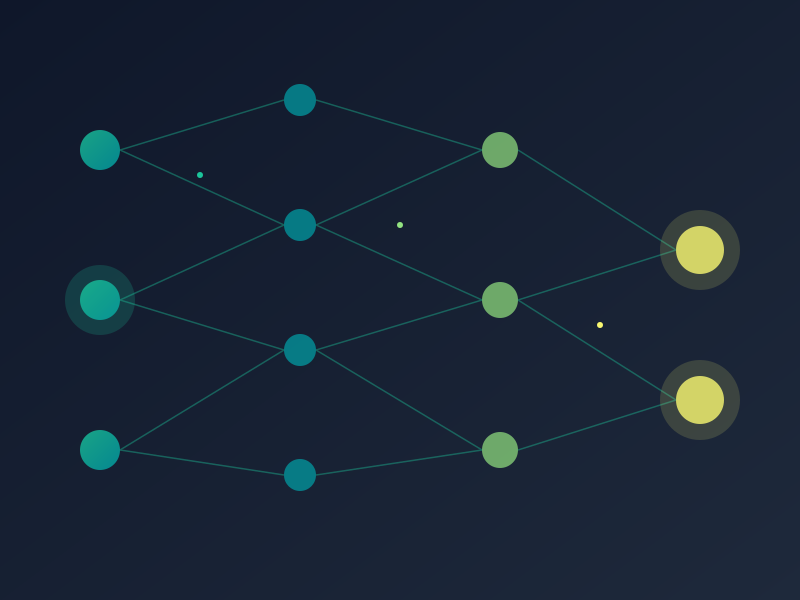
Introduction: What is Agentic AI?
We’re witnessing a fundamental shift in how AI systems operate. While ChatGPT amazed the world with its ability to answer questions and generate text, a new generation of AI is emerging—one that doesn’t just respond, but acts.
Agentic AI refers to AI systems that can autonomously pursue goals by planning multi-step tasks, reasoning through problems, and taking actions in the real world. These aren’t chatbots waiting for your next prompt. They’re autonomous agents that can break down complex objectives, use tools, learn from failures, and iterate until they succeed.
The difference is profound: traditional AI is reactive (you ask, it answers), while agentic AI is proactive (you set a goal, it figures out how to achieve it). This transformation is reshaping everything from software development to scientific research.
The Evolution: From Chatbots to Agents
The journey to agentic AI has been rapid:
2020-2022: The Conversational AI Boom GPT-3 and ChatGPT introduced the world to large language models capable of human-like conversation. But they were fundamentally stateless—each interaction started fresh, with no memory or ability to take action beyond generating text.
2023: Function Calling Arrives OpenAI and Anthropic introduced function calling, allowing LLMs to invoke external tools and APIs. Suddenly, AI could check the weather, query databases, or execute code. This was the birth of true tool use.
2024: The Multi-Agent Era Frameworks like AutoGPT, BabyAGI, LangChain, and CrewAI emerged, enabling multiple AI agents to collaborate on complex tasks. The Model Context Protocol (MCP) standardized how agents interact with tools and data sources.
Today’s agentic AI systems can autonomously:
- Write and debug entire codebases
- Conduct comprehensive research across thousands of papers
- Manage DevOps incidents from detection to resolution
- Orchestrate multi-step workflows across different systems
The Five Pillars of Agentic AI
What makes an AI system “agentic”? Five core capabilities:
1. Reasoning
Modern agents use chain-of-thought prompting to break down complex problems into manageable steps. They don’t just answer—they think through the problem, showing their work:
Goal: Deploy a web app to production

Thought: I need to ensure the app builds correctly first
Action: Run `npm run build`
Observation: Build succeeded

Thought: Now I need to check if the deployment target is configured
Action: Read deployment configuration file
Observation: Config points to production environment

Thought: Everything looks good, I can deploy
Action: Execute deployment command
Observation: Deployment successful
2. Planning
Agents decompose high-level goals into actionable sub-tasks. Given “Build a user authentication system,” an agent might plan:
- Research authentication best practices
- Choose appropriate libraries (bcrypt, JWT)
- Design database schema
- Implement registration endpoint
- Implement login endpoint
- Add password reset functionality
- Write unit tests
- Update documentation
3. Tool Use
The true power of agents emerges when they can interact with the world. Modern agents can:
- Execute code in sandboxed environments
- Call APIs to fetch data or trigger actions
- Search the web for current information
- Read and write files in the filesystem
- Use databases to persist data
- Control other software via command-line tools
Example: A coding agent might search documentation, read existing code, write new functions, run tests, and commit changes—all autonomously.
4. Memory
Unlike stateless chatbots, agents maintain context across interactions:
- Short-term memory: Current task context and recent observations
- Long-term memory: Past successes/failures, learned preferences, project history
- Episodic memory: Specific experiences that inform future decisions
This allows agents to build on previous work and avoid repeating mistakes.
5. Self-Correction
Perhaps most impressively, agents can detect and fix their own errors:
// Agent attempts to implement feature
const result = await agent.execute(task);

if (result.hasError) {
  // Agent analyzes the error
  const diagnosis = await agent.analyze(result.error);

  // Agent tries alternative approach
  const fixedResult = await agent.retry(task, {
    avoiding: diagnosis.problematicApproach,
    using: diagnosis.suggestedFix,
  });
}
This feedback loop is what enables agents to tackle open-ended problems without human intervention.
Real-World Examples in Action
Theory aside, where are agentic AI systems actually being used today?
Coding Assistants: Beyond Autocomplete
Tools like Claude Code, Cursor, and GitHub Copilot represent the cutting edge of agentic AI in software development:
- Claude Code can explore entire codebases, identify bugs across multiple files, suggest architectural improvements, and implement multi-file refactorings—all autonomously
- Cursor integrates deeply with VS Code to provide context-aware code generation that understands your full project structure
- Devin (by Cognition AI) can tackle entire software engineering tasks end-to-end, from reading requirements to deploying code
These aren’t glorified autocomplete. They’re pair programmers that can work independently.
Research Agents: Accelerating Discovery
In academic research, agents are:
- Conducting systematic literature reviews across thousands of papers
- Extracting and synthesizing findings into structured knowledge bases
- Identifying research gaps and suggesting novel experiments
- Analyzing datasets with statistical rigor
One researcher used an agentic system to review 500+ papers on climate modeling in under an hour—a task that would have taken weeks manually.
DevOps: Autonomous Operations
Modern DevOps agents can:
- Detect anomalies in monitoring data
- Diagnose root causes by analyzing logs and metrics
- Apply fixes like restarting services or scaling resources
- Verify resolution through automated testing
- Document incidents for post-mortem review
All without waking up a human at 3 AM.
Customer Service: The Self-Solving Support Ticket
Advanced customer service agents can:
- Understand customer issues from natural language descriptions
- Search knowledge bases and documentation
- Execute account operations (password resets, subscription changes)
- Escalate to humans only when truly necessary
One company reported that their agentic support system resolved 73% of tickets autonomously, with customer satisfaction scores matching human agents.
The Architecture Behind the Magic
How do these systems actually work? Most agentic AI follows the ReAct pattern (Reasoning + Acting):
def agent_loop(goal: str, max_iterations: int = 10):
    context = initialize_context(goal)

    for i in range(max_iterations):
        # 1. THINK: Reason about what to do next
        thought = llm.generate_thought(context)

        # 2. ACT: Choose and execute an action
        action = llm.choose_action(thought, available_tools)
        observation = execute_action(action)

        # 3. OBSERVE: Update context with results
        context.add(thought, action, observation)

        # 4. CHECK: Are we done?
        if is_goal_achieved(goal, context):
            return context.result

    return context  # Timeout - partial progress
This simple loop is remarkably powerful. The agent iteratively:
- Thinks about the current state and what to do next
- Acts by using a tool or taking an action
- Observes the results
- Repeats until the goal is achieved
Multi-Agent Collaboration
For complex tasks, multiple specialized agents can work together:
- A Researcher Agent gathers information
- A Planner Agent designs the implementation
- A Coder Agent writes the code
- A Reviewer Agent checks quality
- A Tester Agent validates functionality
Each agent has a specific role, and they coordinate through a shared workspace or message-passing system.
Tool Orchestration with MCP
The Model Context Protocol (MCP) standardizes how agents connect to tools and data sources. Think of it as USB for AI—a universal interface that allows any agent to use any tool:
// MCP allows agents to discover and use tools dynamically
const tools = await mcp.listTools();
// Returns: [searchWeb, executeCode, readFile, queryDatabase, ...]

// Agent can invoke any tool
const result = await mcp.invokeTool("searchWeb", {
  query: "latest React 19 features",
  maxResults: 5,
});
This standardization is accelerating the ecosystem—developers can build tools once and make them available to all agents.
Challenges and Limitations
Despite their impressive capabilities, agentic AI systems face real challenges:
Reliability and Hallucination
Agents can confidently take wrong actions based on hallucinated information. A coding agent might implement a non-existent API method or cite documentation that doesn’t exist.
Mitigation: Constrain agents to verified information sources, implement validation steps, and use tool use confirmation before destructive operations.
Cost and Latency
Each agent iteration requires LLM inference, which incurs both cost and time. A task requiring 20 reasoning steps might cost $0.50-$2.00 and take 30-60 seconds.
Mitigation: Use smaller models for simple decisions, cache common patterns, and set iteration limits.
Security Concerns
Autonomous agents executing code or accessing systems raise security questions:
- What if an agent is tricked into running malicious code?
- How do we prevent agents from accessing unauthorized data?
- Can agents be used for automated attacks?
Mitigation: Sandboxed execution environments, strict permission models, and human approval for sensitive operations.
When NOT to Use Agents
Agentic AI isn’t always the answer:
- Simple, deterministic tasks are better handled by traditional code
- Tasks requiring human judgment (ethical decisions, creative direction) shouldn’t be fully automated
- Time-sensitive operations may not tolerate agent latency
- Cost-sensitive applications might not justify per-token pricing
Use agents where complexity, variability, and the need for reasoning justify the overhead.
The Future: Where Are We Headed?
The trajectory of agentic AI suggests some profound shifts ahead:
Autonomous Software Development
We’re approaching a future where you can describe a complete application in natural language, and an agent (or team of agents) will design, implement, test, and deploy it. Not “generate boilerplate”—actually build production-ready software.
Early evidence: Startups are already using AI agents to build their MVPs in days instead of months.
Scientific Research Acceleration
Imagine agents that can:
- Design and conduct experiments
- Analyze results and form hypotheses
- Read all published research in a field
- Identify promising research directions
This could compress decades of scientific progress into years.
Personalized Education
AI tutors that understand your learning style, adapt explanations in real-time, create custom exercises, and guide you through complex topics at your own pace—available 24/7 for free.
Healthcare Diagnostics
Agents that review medical literature, analyze patient data, suggest diagnoses, recommend treatments, and explain their reasoning—serving as a second opinion for every doctor.
Ethical Considerations
With great autonomy comes great responsibility. As agents become more capable, we must grapple with:
- Accountability: Who’s responsible when an agent makes a mistake?
- Transparency: Can we understand and audit agent decisions?
- Alignment: How do we ensure agents pursue our goals, not their own?
- Access: Will agentic AI widen or narrow societal inequalities?
These aren’t hypothetical—they’re questions we must answer now.
Conclusion
Agentic AI represents a fundamental evolution in how we interact with machines. We’re moving from tools that require precise instructions to collaborators that understand goals and figure out the details.
This isn’t science fiction—it’s happening now. Claude Code is autonomously refactoring production codebases. Research agents are accelerating scientific discovery. DevOps agents are managing infrastructure 24/7.
The question isn’t whether agentic AI will transform how we work—it’s how quickly, and whether we’ll guide that transformation responsibly.
Ready to experiment? Start small:
- Try Claude Code or Cursor for a real coding task
- Build a simple ReAct agent using the LangChain framework
- Read the Model Context Protocol spec
- Consider: What repetitive task in your work could an agent handle?
The age of autonomous AI is here. The agents are already working. The only question is: are you ready to work with them?
Resources for Getting Started
- Anthropic Claude - Advanced conversational AI with tool use
- LangChain - Framework for building agent applications
- Model Context Protocol - Standard for AI-tool integration
- AutoGPT - Open-source autonomous agent
- ReAct Paper - Original research on reasoning + acting
What are your thoughts on agentic AI? Are you excited, concerned, or both? Let me know on Twitter or LinkedIn.

Written by
J. Jaime Aleman
Developer, writer, and builder. Passionate about web development, AI, and creating digital experiences.